
4 Areas To Review Before Year-End
If you’re like many professional services firms across Las Vegas and Southern Nevada, your business looks different today than it did six months ago.
You’ve hired new employees. Added software. Expanded responsibilities. Maybe you’ve opened a new office, embraced more remote work, or implemented new tools to improve efficiency.
Those are all signs of growth.
But growth often introduces technology and cybersecurity risks that develop quietly in the background.
As organizations evolve, systems change. Employees gain access. New applications are introduced. Vendors come and go. Processes adapt.
The challenge is that most businesses rarely pause to review the cumulative impact of those changes.
By July, many organizations are operating on assumptions about how their systems work, who has access to what, and whether critical safeguards are still aligned with the way the business operates today.
Those assumptions can become costly if they go unchecked.
Here are four areas worth reviewing before the second half of the year gets underway.
Question 1: Access has expanded. Has anyone reviewed it?
When new employees join your organization, they need access quickly.
When team members change roles, they often inherit additional permissions.
When projects require outside support, temporary access is granted to vendors or contractors.
All of those decisions make sense in the moment.
The problem is that access is rarely reviewed after it’s assigned.
Over time, organizations often discover:
- Employees have access to systems they no longer need
- Former employees still have active accounts
- Sensitive client information is available to too many people
- Administrative privileges have expanded unnecessarily
- Nobody has a complete picture of who can access critical systems
For accounting firms, wealth management practices, insurance agencies, engineering firms, and consultants, this creates more than just a security concern.
It creates business risk.
Client trust, compliance obligations, and cyber insurance requirements all depend on maintaining appropriate access controls.
A simple question can reveal a lot:
If someone asked you today who has access to your critical business systems and client information, could you answer confidently?
If that answer requires investigation, it’s worth taking a closer look.
Question 2: New tools solved problems, but created complexity.
Technology decisions are usually made for good reasons.
Your sales team needed a better CRM.
Marketing needed stronger campaign management.
Finance needed a more efficient billing platform.
Operations wanted better project visibility.
Individually, these decisions improve productivity.
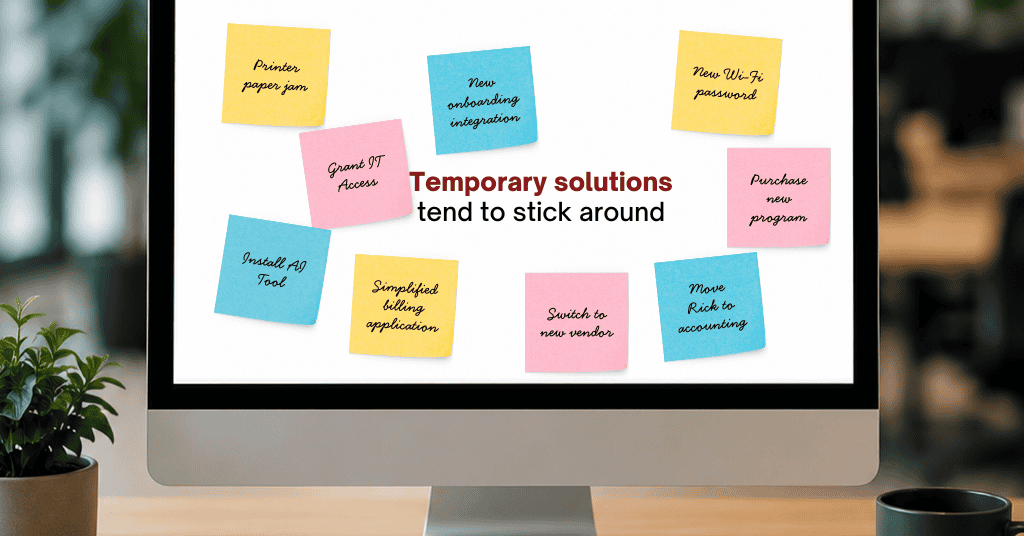
Collectively, they often create a technology environment that’s more complicated than anyone realizes.
Data starts living in multiple locations.
Integrations are configured and forgotten.
Processes become dependent on software that few people fully understand.
Reporting becomes inconsistent.
Employees create manual workarounds to compensate for disconnected systems.
The result isn’t always an immediate problem.
More often, the impact shows up gradually through:
- Slower decision-making
- Data inconsistencies
- Compliance challenges
- Security blind spots
- Reduced operational efficiency
We’ve seen this happen in growing Southern Nevada firms where technology evolved faster than documentation, governance, or oversight.
The risk isn’t that your systems are failing.
The risk is that nobody owns the complete picture.
Are your systems truly working together, or has your team quietly adapted around technology gaps?
The answer often reveals opportunities to improve both security and productivity.
Question 3: Are you confident in your ability to recover?
Most businesses have backups.
Far fewer have tested them.
That’s an important distinction.
Having backups creates a sense of security.
Knowing exactly how quickly your business can recover after a ransomware attack, server failure, accidental deletion, or cloud outage creates actual confidence.
Unfortunately, many organizations don’t discover weaknesses in their recovery process until they’re already dealing with an emergency.
At that point, questions start surfacing quickly:
- How recent is our backup?
- Who is responsible for recovery?
- How long will this take?
- Can employees continue working?
- Will clients be impacted?
- Are we meeting cyber insurance requirements?
For professional services firms, downtime isn’t simply an inconvenience.
It can affect client relationships, revenue, productivity, and reputation.
Business leaders should know:
- How backups are being monitored
- How often recovery testing occurs
- How long restoration would take
- Which systems receive priority
- Who is responsible for coordinating recovery efforts
If your systems became unavailable tomorrow, would your leadership team know exactly what happens next?
Or would everyone be creating the plan while the crisis is already underway?
Question 4: Has ownership become unclear as your business has grown?
One of the most common challenges we encounter isn’t broken technology.
It’s unclear accountability.
At one point, ownership was straightforward.
Internal staff managed certain responsibilities.
Technology vendors managed others.
Everyone generally knew where issues belonged.
Then growth happened.
Additional software was implemented.
New vendors were added.
Employees changed positions.
Remote work expanded.
Processes evolved.
Somewhere along the way, responsibility became less clear.
When an issue affects multiple systems, determining who owns the problem often becomes part of the problem.
Issues get bounced between vendors.
Small concerns remain unresolved longer than they should.
Leadership spends time coordinating instead of solving.
“Who is responsible for this?” When something significant happens, business leaders should have the answer already defined.
Clear ownership reduces downtime, improves response times, and prevents small issues from becoming larger business disruptions.
A Midyear Review Can Also Strengthen Compliance And Cyber Insurance Readiness
For many Southern Nevada organizations, the second half of the year brings compliance reviews, cyber insurance renewals, budgeting discussions, and strategic planning.
These events often expose technology gaps that have been developing quietly throughout the year.
Questions like:
- Are we meeting current cybersecurity requirements?
- Have our risks changed since our last assessment?
- Do our security controls support our insurance coverage?
- Are we protecting sensitive client information appropriately?
- Would we be prepared for an audit or security incident?
The best time to answer these questions is before they’re asked by an auditor, insurance provider, or client.
Most Technology Risk Doesn’t Come From What’s Broken
It Comes From What’s Changed.
The organizations that stay ahead of cybersecurity and operational risk aren’t necessarily doing anything complicated.
They simply revisit their environment regularly.
They understand:
- Who has access to what
- How data moves through the organization
- Whether recovery plans actually work
- Who owns critical responsibilities
- Whether security controls still align with business objectives
That clarity creates confidence.
It helps leadership make informed decisions, reduce risk, maintain compliance, and continue growing without unnecessary surprises.
At Orbis Solutions, we help professional services firms throughout Las Vegas and Southern Nevada gain that clarity.
Our team works with business leaders every day to identify overlooked risks, strengthen cybersecurity, improve accountability, and ensure technology supports business goals rather than creating uncertainty.
If you’re unsure whether your systems still reflect the way your business operates today, now is a great time for a midyear review.
A conversation today can help uncover issues before they become costly problems tomorrow.
Contact Orbis Solutions to schedule a technology and cybersecurity assessment and gain a clearer understanding of where your organization stands today.


